
American Football Origin: The Full Story of How America’s Favorite Sport Began
American football is among the most popular and prominent sports in the United States. Every year, millions of fans congregate in stadiums, watch games on television, and rally behind their favorite clubs. Football is profoundly ingrained in American society. High American football is one of the most popular and influential sports in the United States. Every year, millions of fans gather in stadiums, watch games on television, and passionately support their favorite teams. From high school competitions to college championships and professional leagues, football has become deeply woven into American culture.
School competitions to college championships and professional leagues.
But many individuals are curious about the sport’s roots. How did the sport of American football begin? Why is it called “football” when the players primarily use their hands? Who developed the rules that evolved into the contemporary game we know today?
The history of American football is remarkable because it encompasses centuries of athletic evolution, cultural influence, and innovation. The sport did not develop overnight. Instead, it evolved gradually from older games popular in Britain before becoming a distinctly American product.
This article examines the origins of American football and its evolution into one of the world’s most popular sports.
The Ancient Origins of Football
Football originated hundreds of years before American football.
Throughout medieval Europe, people played various ball sports that required moving a ball towards a goal. These games typically had few rules and may be exceedingly brutal. Entire villages occasionally took part, and contests could include dozens or even hundreds of players.
The word “football” originally referred to sports played on foot rather than horseback. Contrary to popular assumption, the word did not always refer to kicking the ball. Many early football games let players carry, toss, or kick the ball. The main difference was that the contestants were playing on foot rather than on horseback.
As these traditional games evolved, different schools and regions developed their own variations, which helped shape modern football.
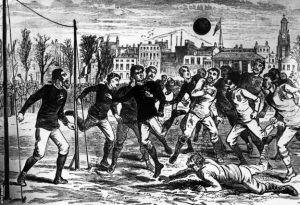
The Origins of Association Football and Rugby
In the nineteenth century, British schools began developing systematic regulations for football matches.
Two significant forms emerged:
Association football
In 1863, the English Football Association developed standardized rules that govern association football. This variation emphasizes kicking while limiting the use of hands. It gradually evolved into the sport that is now known as football around the world. In the United States and Canada, it became known as soccer.
The term “soccer” originated in Britain. It derived from the term “association football,” which was abbreviated to “assoc.” British students then changed it to “soccer,” utilizing current lingo at the time.
Rugby football
Another variant was produced at Rugby School in England. According to legend, a student called William Webb Ellis picked up the ball during a game and ran with it instead of kicking it. Whether the narrative is totally accurate is debatable, but it formed part of rugby’s founding story.
Rugby allowed players to carry the ball, make physical contact, and tackle, making it more similar to modern American football than soccer.
Football Arrives in America.
Soccer and rugby crossed the Atlantic in the nineteenth century.
These new sports immediately gained popularity among American colleges. However, various schools played by different rules, which caused confusion when teams competed against one another.
American football looked quite different in its early years than it does today. There were no quarterbacks, no forward throws, and no structured offensive formations.
Instead, teams frequently used a jumbled blend of soccer and rugby regulations.
The first acknowledged intercollegiate football game in the United States occurred on November 6, 1869, between Rutgers University and Princeton University in New Jersey. The game resembled soccer more than modern football, and the London Football Association provided the rules.
Although historians consider the match the first college football game, modern fans would hardly recognize it as such.
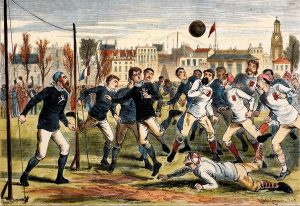
The Rugby Influence
Rugby gained traction on American college campuses in the 1870s.
One of the most significant instances came when Harvard University played a series of matches versus McGill University in Canada.
McGill used rugby-style regulations, and Harvard immediately adopted many of them. Other colleges quickly followed.
As rugby spread across American campuses, the game evolved from soccer to a more physical version that emphasized running, tackling, and ball carrying.
This rugby impact explains many elements that remain present in football today, including:
• Tackling
• Running plays.
• The oval-shaped ball.
• Strategic field advancement.
• Physical line play.
Even the shape of the football stems from rugby traditions. Early footballs had oval forms similar to rugby balls before evolving into the current prolate spheroid shape we see today.
Walter Camp, The Father of American Football
Walter Camp had the greatest influence on the evolution of American football.
Camp, nicknamed the “Father of American Football,” converted rugby-based sports into the distinctly American sport we know today.
Camp played football at Yale University and later served on rule-making committees. He considered that the present game was too chaotic and required structure.
Beginning in the late 1870s and lasting decades, Camp developed improvements that significantly altered the sport.
Line of scrimmage
One of Camp’s most significant accomplishments was to replace the rugby scrum with the line of scrimmage.
Instead of players battling for possession in a big pile, the team in possession would start each play from a specific place.
This move resulted in improved organization and strategy.
The Snap Camp introduced the snap from center to quarterback.
This breakthrough established the foundation for modern offensive play, enabling teams to implement planned strategies instead of depending on chaotic struggles for possession.
The Down System
Another innovative breakthrough was the development of downs.
Teams were expected to progress a specific distance during a particular number of plays or give up possession.
This rule remains one of football’s defining traits, contributing to much of the strategic tension observed in modern games.
Eleven-player teams
Camp helped to standardize the team size at eleven players.
This change boosted speed, opened up more space, and encouraged strategic specialization among players.
The quarterback positions
The quarterback position arose as a result of Camp’s inventions.
Today, quarterbacks are widely regarded as the most essential players on the field, leading offenses and making critical decisions during games.
Why is it called football?
One of the most commonly asked questions is why American football is named football, given that players mostly use their hands.
The solution lies in the sport’s historical roots.
American football arose from older football traditions that already used the name. Rugby and association football were both part of a larger family of sports known as football. When the American version appeared, it kept the name because it was regarded as a different branch of the football family.
In other words, the term existed long before modern rules were established.
Football is called “football” not because kicking is the dominant skill in the game but because it is part of the historical football tradition that arose from older British sports.
Safety Issues and Rule Changes
Football’s physical nature raised safety issues nearly from the start.
Injuries and fatalities increased in the late nineteenth and early twentieth centuries. Critics said that the sport was extremely risky.
In response, rule makers made considerable revisions.
The most significant was the legalization of forward passes in 1906.
The forward pass allowed players to spread out across the field, reducing dangerous mass formations and encouraging a more open style of play. It also made football faster and more thrilling.
Simultaneously, protective equipment progressively becomes the norm.
Players started wearing:
• Wear helmets.
• Shoulder pads.
• Hip pads.
• Thigh pads
• Mouthguards.
These enhancements increased safety while allowing the game to retain its physical appearance.
The Growth of Professional Football
For many years, football was mostly a collegiate sport.
College teams drew massive audiences and received extensive media attention. Universities have been the sport’s most visible institutions.
Professional football developed gradually in the early twentieth century. At first, professional clubs struggled to compete with college football’s popularity.
Everything changed with the establishment and expansion of the National Football League.
The National Football League eventually became the world’s preeminent football organization. Television broadcasts, superstar athletes, and championship games all contributed to professional football’s rise to national prominence.
Today, the NFL makes billions of dollars annually and draws fans from all over the world.
Football becomes a cultural institution.
By the mid-twentieth century, football had evolved into more than just a sport.
It became a cultural institution.
High schools established football programs to promote school spirit. Colleges formed famous rivalries. Professional sports teams become emblems of cities and regions.
Football has influenced the following:
• Television programming.
• Advertising.
• Fashion.
• Music.
• Community traditions
Events like the Super Bowl have turned into massive cultural festivities that are viewed by hundreds of millions of people across the world.
Despite continuous arguments over player safety and health, the sport’s popularity continues to increase.
Evolution of Modern Football
Modern football is constantly evolving.
In recent decades, we have seen:
• Utilize advanced training methodologies.
• Improved safety equipment.
• Sophisticated analytics.
• Enhanced officiating technology.
• Improved international reach
Coaches are now using sophisticated statistical information to guide decisions. Players participate in highly specialized training regimens. Medical science has enhanced our understanding of injury and recovery.
Despite these adjustments, Walter Camp’s original structure remains mostly intact.
The line of scrimmage, downs system, quarterback position, and strategic play-calling remain the game’s defining features.
Lasting Legacy
The history of American football exemplifies how sports change via innovation, adaptation, and cultural influence.
What started as a collection of informal football games in Britain evolved into a uniquely American sport. Influences from soccer and rugby were merged with the ingenuity of American colleges and visionary leaders such as Walter Camp to create an altogether new sport.
American football has become one of the world’s most recognized sports. Its extensive history reveals not only how the game evolved, but also why it continues to attract millions of enthusiasts year after year.
From muddy college grounds in the eighteenth century to packed professional stadiums and global broadcasts, the history of American football exemplifies sport’s ability to evolve, inspire, and unify people across generations.
Conclusion
American football’s origins are a story of transformation. The sport evolved from centuries-old football traditions, highly inspired by rugby and soccer, and altered by Walter Camp’s breakthrough inventions, eventually becoming a completely American product. The inaugural collegiate game in 1869 established the groundwork, but decades of rule revisions, strategic breakthroughs, and cultural expansion transformed football into the sport we know today.
Understanding the history of American football allows us to understand why the sport is called football, how its unique rules evolved, and why it is still such an important part of American culture. Football is more than just a game; it represents history, competition, teamwork, and creativity, leaving a legacy that grows with each generation.