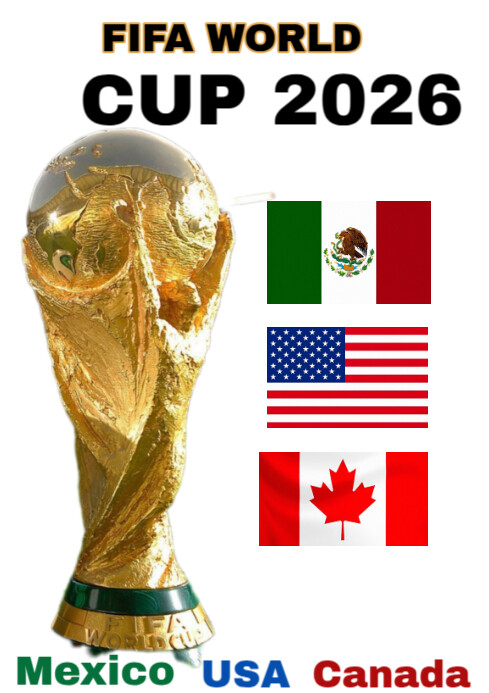
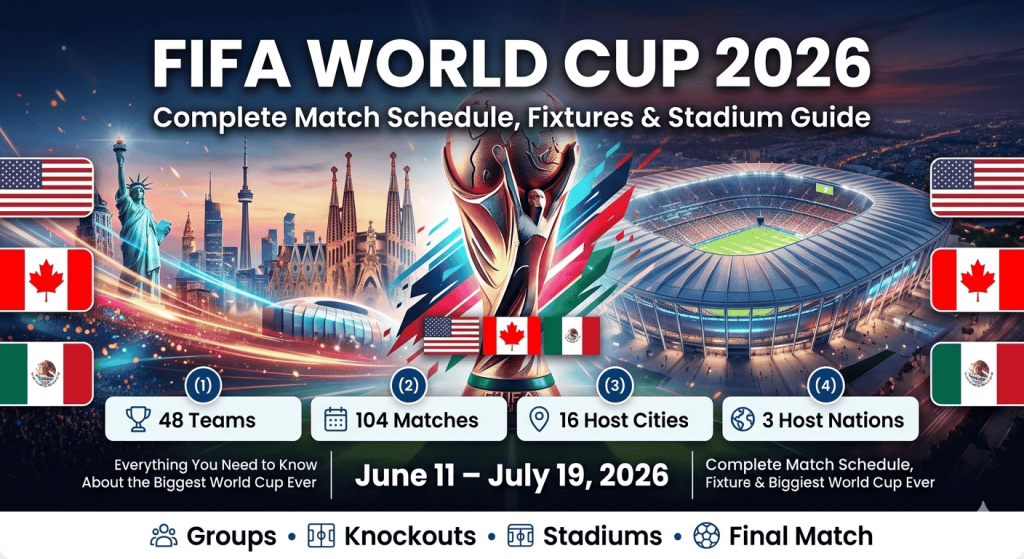
The FIFA World Cup 2026 is expected to be the largest and most ambitious football event ever organised. For the first time ever, 48 national teams will compete in three host countries: the United States, Canada, and Mexico. This historic increase from 32 to 48 teams will result in more matches, excitement, and possibilities for nations to compete on football’s grandest stage.
Football enthusiasts worldwide are anxiously counting down the days till the competition begins. With 104 matches scheduled across sixteen stunning stadiums, the FIFA World Cup 2026 promises extraordinary moments, dramatic upsets, iconic performances, and historic accomplishments.
Understanding the World Cup 2026 itinerary is vital if you intend to attend matches in person, travel between host cities, or simply watch the event from home. This thorough guide contains all you need to know, including tournament dates, match schedules, host stadiums, knockout rounds, and must-see football games.
FIFA World Cup 2026 Overview.
The FIFA World Cup 2026 will usher in a new era in international football. The competition, co-hosted by the United States, Canada, and Mexico, marks the first time three countries have shared a World Cup.
The competition officially begins on June 11, 2026, and ends on July 19, 2026. During this time, the world’s best football teams will compete for the most coveted trophy in sports.
FIFA World Cup 2026 Tournament Schedule
| Stage / Round | Dates | Key Match Highlights / Locations |
| Group Stage | June 11 – June 27, 2026 | • June 11: Opening Match (Mexico vs. South Africa) at Estadio Azteca • June 12: Canada opener (vs. Bosnia and Herzegovina); USA opener (vs Paraguay) • Contains 72 group-stage matches across 12 groups |
| Round of 32 | June 28 – July 3, 2026 | • Expanded knockout stage debut • First-place and select third-place finishers advance |
| Round of 16 | July 4 – July 7, 2026 | • Knockout phase continues across major North American hubs |
| Quarter-finals | July 9 – July 11, 2026 | • The final 8 teams battle for a spot in the semi-finals |
| Semi-finals | July 14 – July 15, 2026 | • Penultimate round hosted at selected marquee venues |
| Third-Place Play-off | July 18, 2026 | • Hosted at Hard Rock Stadium in Miami, FL |
| World Cup Final | July 19, 2026 | • Hosted at New York/New Jersey Stadium (MetLife Stadium) |
The extended format will contain:
* There are 48 participating teams.
* 12 groupings with four teams.
* 104 total matches.
* 16 host cities.
* 39 Tournament Days
* Three host countries.
This expansion reflects FIFA’s ambition of making the competition more inclusive by inviting more countries from all continents to compete.
The 2026 World Cup will also be the largest in terms of attendance, viewership, and global influence.
Why is the 2026 World Cup schedule different?
Previous World Cups had 32 teams competing in eight groups. However, the 2026 event features an entirely new format.
The 48 competing teams will be split into twelve groups. Each squad will participate in three group stage matches. The top two teams from each group, together with the eight best third-place teams, will proceed to the knockout round.
This new format includes an additional knockout round known as the Round of 32.
As a result, fans will be able to enjoy more football than ever before. Instead of 64 matchups, the event will have an astonishing 104 contests distributed across North America.
The new format also provides more opportunity for growing football nations to compete with traditional football powers.
Opening Match and Tournament Kickoff
The FIFA World Cup 2026 kicks off on June 11, 2026, at Mexico City’s legendary Estadio Azteca.
This iconic stadium has already held two World Cup finals and will be the first site in football history to host matches from three different FIFA World Cups.
The opening ceremony is scheduled to be a spectacular celebration of football culture, including music, entertainment, and the rich traditions of the host countries.
Millions of fans worldwide will tune in to witness the tournament’s official start.
The first week of the competition is likely to be quite exciting as teams want to create a good first impression.
Group Stage Schedule
The group stage lasts from June 11 to June 27, 2026.
During this time, each side will play three matches to qualify for the knockout rounds.
The group stage is sometimes one of the most entertaining stages of the World Cup since it includes a mix of football legends, rising nations, surprising results, and dramatic moments.
Fans can expect daily football action in numerous host locations.
Some of the world’s most successful teams, including Argentina, Brazil, France, England, Germany, Spain, Portugal, and the Netherlands, will launch their campaigns at this stage.
The group stage also allows underdog nations to stun the football world and generate unforgettable World Cup storylines.
Historically, many of football’s most shocking upsets have occurred in the tournament’s first rounds.
Host Cities in North America
One of the most distinctive characteristics of the FIFA World Cup 2026 schedule is the tournament’s global scope.
The matches will take place in sixteen cities spread across three countries.
Host Cities in the United States
The vast majority of matches will take place in the United States. Host cities include:
* New York/New Jersey.
* Los Angeles.
* Dallas.
* Houston.
* Atlanta.
* Miami.
* BOSTON
* Philadelphia.
* Seattle
* Kansas City.
* San Francisco Bay Area.
These cities have some of the world’s most advanced sporting stadiums and are set to host millions of visitors throughout the event.
Canadian Host Cities
Canada will stage matches in:
* Toronto
* Vancouver.
Both towns have world-class infrastructure and diverse multinational communities, creating a friendly environment for fans.
Mexican Host Cities
Mexico’s host cities are:
* Mexico City.
* Guadalajara.
* Monterrey
Mexican football culture is among the most passionate in the world, making for unique experiences for fans.
The Most Important Stadiums
The FIFA World Cup 2026 will feature some of the largest and most advanced venues ever built for a World Cup.
Stadium Azteca
Estadio Azteca, located in Mexico City, is one of the most famous football stadiums. It previously hosted World Cup finals in 1970 and 1986.
Legends such as Pelé and Diego Maradona made history at this stadium.
MetLife Stadium
This stadium, located in New Jersey, will host the FIFA World Cup Final in 2026.
With a capacity of over 80,000 people, it provides an amazing environment for football’s biggest game.
SoFi Stadium
SoFi Stadium, located in Los Angeles, is one of the world’s most technologically advanced sports venues.
Its modern design and great facilities make it one of the tournament’s top venues.
AT & T Stadium
Located in Dallas, Texas, this stadium is likely to host several key knockout-round matches and draw large crowds.
Round of 32: A New Chapter.
One of the most significant modifications to the 2026 World Cup calendar is the introduction of the Round of 32.
This phase starts immediately following the group stage.
Thirty-two teams will compete in a single-elimination knockout style, with each match being a must-win.
The addition of this stage heightens the tournament’s interest by allowing more nations to go to the knockout rounds.
For spectators, this means more high-stakes matches with some of the world’s finest players.
The Round of 32 is expected to be plenty of surprises and dramatic moments.
Round of 16
Following the Round of 32, the remaining sixteen teams proceed to the Round of 16.
Historically, this stage frequently separates serious title candidates from the rest of the field.
To be successful, teams must display tactical discipline, mental strength, and consistency.
Every mistake becomes more costly, and pressure levels rise dramatically.
Many great World Cup classics have occurred during the Round of 16, and the 2026 event is set to follow this trend.
Quarter-Finals
The quarter-finals are the moment at which just eight teams remain.
At this point, each nation is only three victories away from becoming world champion.
Because only elite teams remain, the quality of football usually peaks during the quarter-finals.
These games frequently result in the creation of football legends.
Players recognise the value of giving their all, whether it’s through amazing goals, heroic saves, or inspirational leadership.
Fans may expect some of the most exciting matches of the competition.
Semi-Finals
The semi-finals are some of the most emotionally charged contests in sport.
Only four teams remain, and each player is aware that a spot in the World Cup Final is within grasp.
The pressure is high since winning means a chance to compete for football’s most prestigious trophy.
Many of football’s most famous moments have occurred during the World Cup semi-finals.
These games frequently involve tactical fights, dramatic goals, and standout individual performances.
For fans, the semi-finals feature some of the most thrilling football of the competition.
Third-place Playoff
The third-place match occurs just before the final.
Although the competing teams may be unhappy after losing in the semi-finals, finishing third is a big accomplishment.
This encounter frequently results in attractive football since teams play with more flexibility and less pressure.
Many players see it as an opportunity to end the competition on a positive note and leave a lasting impression.
FIFA World Cup 2026 Final
The FIFA World Cup 2026 Final will take place on July 19, 2026.
The final is predicted to have one of the highest global television viewerships in sports history.
Billions of people will watch as two nations compete for football’s ultimate reward.
Reaching the World Cup Final is a lifelong ambition come true for players, managers, and supporters.
The victorious squad will go down in football history as one of the most successful World Cup winners.
The subsequent celebrations will be remembered for generations.
Players Who Could Dominate the Tournament:
The World Cup schedule gives football fans the opportunity to see some of the sport’s best names.
Several players are expected to play significant roles in the competition, including:
* Kylian Mbappe.
* Erling Haaland.
* Jude Bellingham.
* Vinícius Júnior.
* Lamine Yamal.
* Harry Kane.
* Mohamed Salah.
* Jamal Musiala.
These players could define the tournament with goals, assists, leadership, and spectacular performances.
Why World Cup 2026 Could Be the Best Ever
Several indicators indicate that the FIFA World Cup 2026 could be the greatest World Cup in history.
First, the larger format enables more nations to participate, enhancing global representation.
Second, the tournament’s three-country hosting structure offers fans a unique cultural experience.
Third, modern stadiums, better transportation systems, and cutting-edge technology will improve the overall experience.
Finally, the present crop of football talent is among the best in recent memory, guaranteeing high-quality competition throughout the tournament.
These characteristics, when combined, have the potential to make the World Cup genuinely historic.
Conclusion
The FIFA World Cup 2026 programme promises six weeks of incredible football activity. From the first match in Mexico City to the final in New Jersey, fans will witness the largest and most ambitious World Cup ever held.
With 48 teams, 104 matches, sixteen host cities, and innumerable world-class players, the event marks a new era in football history. Every level of the competition, from the group phase to the final, will be filled with excitement, drama, and unforgettable moments for football lovers.
Whether you root for a traditional powerhouse like Argentina, Brazil, France, Germany, England, or Spain, or an emerging football nation looking to make history, the FIFA World Cup 2026 has something for everyone.