Mikel Merino Sends Spain Into the Quarter-Finals as Portugal’s World Cup Dream Ends
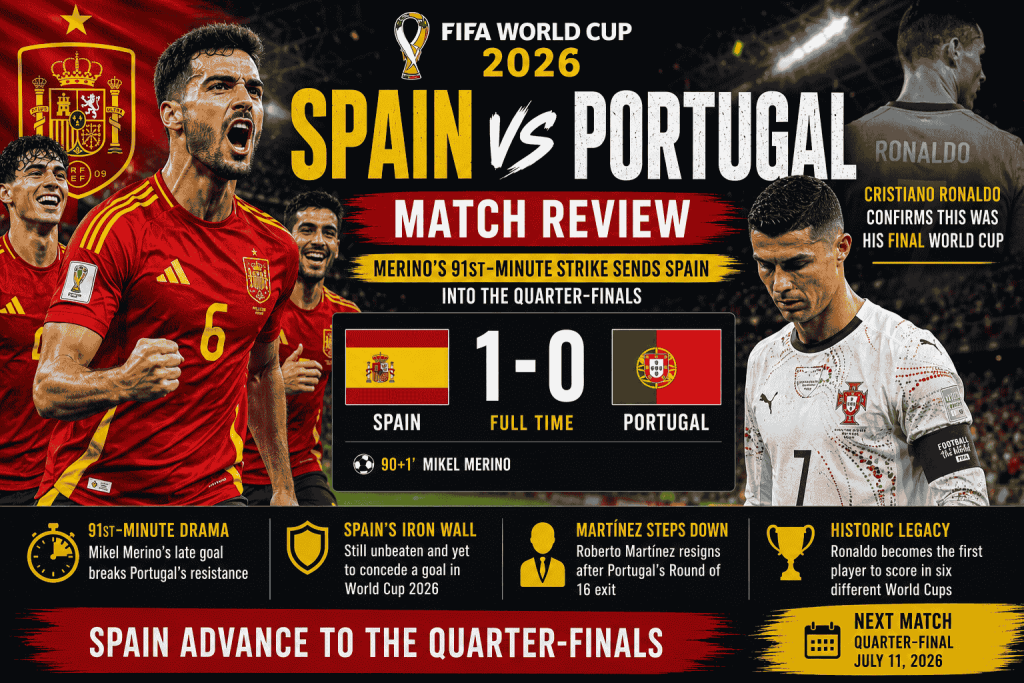
The Spain vs Portugal Match Review will be remembered as one of the most dramatic and emotionally charged encounters of the FIFA World Cup 2026. In a match dominated by tactical discipline, defensive organization, and nerve-wracking tension, Spain booked their place in the quarter-finals with a dramatic 91st-minute winner from substitute Mikel Merino, defeating Portugal 1-0 before a capacity crowd at Dallas Stadium.
For over ninety minutes, the Iberian rivals battled in a fascinating tactical contest where every inch of space had to be earned. Spain controlled possession for much of the evening, patiently probing Portugal’s compact defensive block, while Roberto Martínez’s side relied on disciplined defending and dangerous counterattacks to keep their knockout hopes alive.
Just when extra time seemed inevitable, Spain finally found the breakthrough. Alejandro Grimaldo delivered a perfectly weighted pass into the penalty area, and Merino calmly slotted home to send Spanish supporters into celebration while breaking Portuguese hearts.
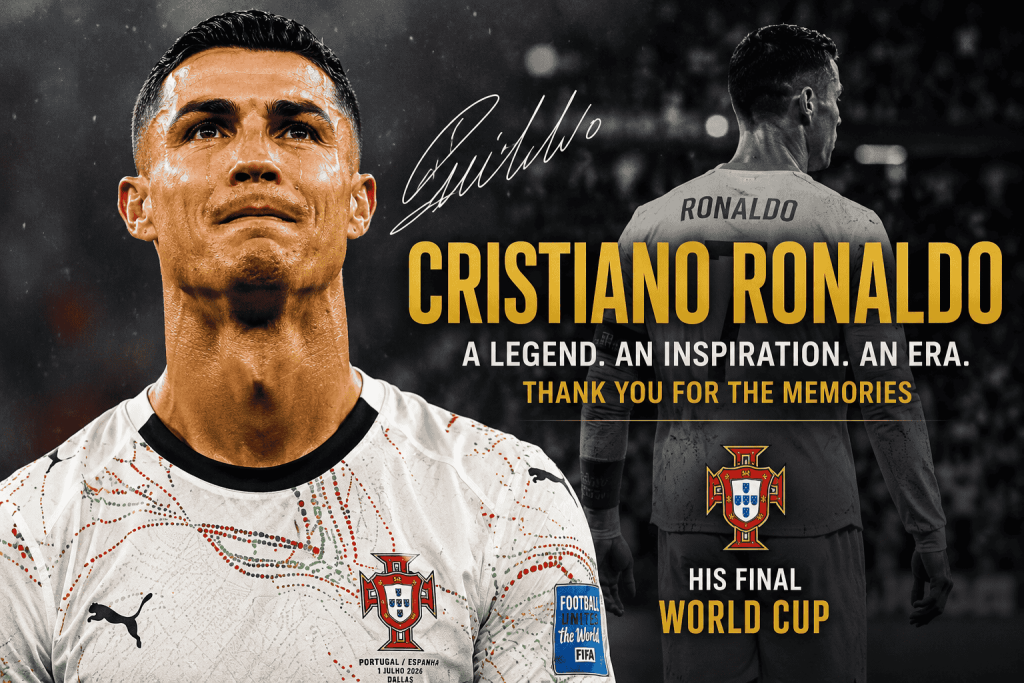
The defeat not only ended Portugal’s World Cup journey but also marked the conclusion of an unforgettable era. Following the match, Cristiano Ronaldo confirmed that this was the final FIFA World Cup appearance of his extraordinary career, bringing an emotional close to one of the greatest World Cup stories football has ever witnessed. Shortly afterward, Portugal head coach Roberto Martínez also announced that he would step down, signaling the beginning of a new chapter for Portuguese football.
Meanwhile, Spain continued their remarkable tournament by extending their defensive record. Luis de la Fuente’s side reached the quarter-finals without conceding a single goal, strengthening their credentials as genuine contenders for the 2026 FIFA World Cup title.
Match Summary
Competition: FIFA World Cup 2026 – Round of 16
Venue: Dallas Stadium
Attendance: Packed Crowd
Final Score
Spain 1-0 Portugal
Goalscorer
⚽ Mikel Merino (90+1′)
Match Statistics
| Match Statistics | Portugal | Spain |
|---|---|---|
| Possession | 38% | 62% |
| Shots | 8 | 11 |
| Shots on Target | 2 | 4 |
| Corners | 3 | 6 |
| Fouls | 12 | 9 |
| Yellow Cards | 3 | 1 |
The statistics reflected the tactical pattern of the contest. Spain dominated possession and patiently built attacks, while Portugal remained compact, disciplined, and dangerous whenever opportunities appeared on the counterattack.
An Iberian Derby Filled With Tactical Intelligence
Whenever Spain and Portugal meet on football’s biggest stage, supporters expect passion, quality, and unforgettable moments.
This encounter delivered all three.
Instead of becoming an open attacking contest, the match developed into a fascinating tactical battle between two experienced international managers.
Luis de la Fuente instructed Spain to remain patient in possession rather than forcing risky passes through Portugal’s defensive structure.
Roberto Martínez, meanwhile, accepted that his side would spend long periods without the ball.
Portugal’s strategy focused on:
- Maintaining a compact defensive block
- Limiting space between midfield and defense
- Preventing Spain from creating central overloads
- Waiting patiently for counterattacking opportunities
For almost the entire match, the Portuguese plan worked brilliantly.
Spain dominated possession but struggled to convert control into genuine scoring opportunities.
Spain Continue Their Possession Philosophy
Throughout the tournament, Spain had demonstrated one of the clearest football identities of any nation.
Against Portugal, that philosophy remained unchanged.
The midfield trio continuously recycled possession, switching play from flank to flank while looking for weaknesses in Portugal’s defensive organization.
Pedri dictated the tempo with intelligent passing, while Rodri controlled the deeper midfield areas, ensuring Spain rarely lost possession in dangerous positions.
The full-backs pushed high into advanced positions, attempting to stretch Portugal’s defensive line.
Despite enjoying more than sixty percent possession, Spain discovered that controlling the ball is very different from creating clear chances.
Portugal defended with exceptional discipline.
Portugal’s Defensive Masterclass
Although they eventually suffered heartbreak, Portugal deserved enormous credit for their defensive organization.
Martínez instructed his players to defend in two compact lines.
The distances between defenders and midfielders remained extremely small, preventing Spain from finding passing lanes through the center.
Whenever Spain attempted to attack wide areas, Portugal’s defenders responded aggressively.
Crosses into the penalty area were cleared confidently.
Second balls were contested with intensity.
Every Portuguese player understood their defensive responsibilities.
It was one of the most organized defensive performances of the tournament.
First Half: Tactical Chess Rather Than Attacking Fireworks
The opening forty-five minutes resembled a high-level chess match.
Neither side wanted to make the first major mistake.
Spain circulated possession with patience.
Portugal waited for moments to counterattack.
Every attack required precision.
Every defensive movement demanded concentration.
Nico Williams Produces The First Real Threat
Spain created the first meaningful opportunity in the twelfth minute.
Receiving possession on the left wing, Nico Williams drove inside his marker before curling a low effort toward the far corner.
Portugal goalkeeper Diogo Costa remained alert.
The goalkeeper comfortably gathered the shot, preventing Spain from taking an early advantage.
Although it was not the most difficult save of his evening, it demonstrated Spain’s intention to attack through the pace and creativity of Williams.
Portugal Respond Through Bernardo Silva
Portugal gradually settled into the match.
Rather than attempting lengthy possession sequences, Martínez encouraged quick vertical transitions.
One of those attacks almost produced the opening goal.
Bruno Fernandes intercepted possession before immediately releasing Bernardo Silva into space.
The Manchester City midfielder surged forward and attempted a dangerous cross across Spain’s penalty area.
Fortunately for Spain, Aymeric Laporte produced a perfectly timed sliding interception.
The clearance prevented what looked like a certain scoring opportunity.
It highlighted Portugal’s greatest attacking weapon throughout the evening—rapid transitions.
Midfield Battle Defines The Opening Half
Much of the first half was decided in midfield.
Rodri and Pedri attempted to dictate Spain’s rhythm.
Portugal responded with physical intensity.
João Palhinha constantly disrupted Spanish attacks.
Whenever Spain attempted to accelerate the tempo, Palhinha was often positioned perfectly to break up play.
His commitment eventually earned him a yellow card in the forty-first minute after stopping another dangerous run from Pedri.
Although the booking limited his aggression for the remainder of the match, his contribution before halftime had been outstanding.
Spain Search For A Breakthrough
Despite controlling possession, Spain entered halftime frustrated.
Portugal’s defensive shape had successfully forced La Roja into speculative long-range efforts and harmless crosses.
Several sections of the Spanish support applauded their team’s patience.
Others grew increasingly anxious.
Everyone understood that knockout football often depends upon a single decisive moment.
As halftime arrived with the score still level, both managers knew tactical adjustments would likely determine who reached the quarter-finals.
Second Half Begins With Familiar Patterns
The second period started much like the first.
Spain controlled possession.
Portugal defended with discipline.
The Portuguese center-backs dealt confidently with aerial deliveries from Dani Carvajal and the Spanish full-backs.
Every clearance increased Portugal’s belief.
Every unsuccessful Spanish attack increased the tension inside Dallas Stadium.
Although Spain enjoyed territorial dominance, genuine scoring opportunities remained extremely limited.
Portugal’s low defensive block continued frustrating one of Europe’s most technically gifted teams.
Luis de la Fuente Makes A Bold Tactical Gamble
Recognizing that his side required fresh attacking ideas, Spain manager Luis de la Fuente acted decisively in the seventy-second minute.
He introduced three substitutes simultaneously.
The arrivals included:
- Mikel Merino
- Dani Olmo
- Alejandro Grimaldo
The triple substitution immediately altered Spain’s attacking rhythm.
Merino provided more physical presence inside the penalty area.
Olmo offered greater creativity between Portugal’s defensive lines.
Grimaldo introduced fresh energy and more dangerous deliveries from wide positions.
The tactical adjustment would eventually decide the match.
Cristiano Ronaldo Searches For One More Magical Moment
As the match entered its closing stages, Cristiano Ronaldo remained determined to inspire Portugal once again.
Although Spain’s defenders had limited his influence for much of the evening, great players require only one opportunity.
That chance arrived in the eighty-fourth minute.
Portugal earned a corner.
The cross found Ronaldo rising above the Spanish defense.
For a brief second, the entire stadium held its breath.
The header sailed narrowly over the crossbar.
It was Portugal’s best opportunity of the second half.
Ronaldo dropped to his knees in frustration.
He understood how precious chances become in World Cup knockout football.
The Final Minutes: Pressure Reaches Breaking Point
As the match entered its closing stages, the atmosphere inside Dallas Stadium became electric. Both sets of supporters sensed that a single moment of brilliance—or a costly mistake—would determine who progressed to the FIFA World Cup 2026 quarter-finals.
Spain continued to circulate possession with confidence, but Portugal refused to abandon their disciplined defensive shape. Every clearance was celebrated by the Portuguese players as though it were a goal, while Spain grew increasingly desperate to avoid the uncertainty of extra time.
Luis de la Fuente urged his players forward from the technical area, encouraging quicker passing and greater movement between the lines. On the opposite touchline, Roberto Martínez repeatedly instructed his defenders to remain compact and avoid unnecessary risks.
With the clock ticking into stoppage time, both teams appeared mentally prepared for an additional thirty minutes.
Then came the defining moment.
Mikel Merino Delivers the Knockout Blow
In the first minute of stoppage time, Spain finally unlocked Portugal’s stubborn defensive wall.
Alejandro Grimaldo, who had injected fresh energy after coming off the bench, received possession on the left side of the penalty area. Instead of delivering a traditional cross, he showed remarkable composure by driving a low pass into a crowded penalty box.
The delivery split Portugal’s defensive line.
Mikel Merino anticipated the move perfectly.
Finding just enough space between the two central defenders, the midfielder calmly controlled his movement before placing a precise right-footed finish into the bottom-right corner beyond the reach of Diogo Costa.
For a brief second, the stadium fell silent.
Then the Spanish section erupted.
Players sprinted toward the corner flag as Merino was buried beneath celebrating teammates. Luis de la Fuente punched the air in celebration, while Portugal’s players stood frozen in disbelief.
After ninety minutes of tactical discipline, Spain had finally discovered the decisive breakthrough.
Portugal Throw Everything Forward
Conceding so late left Portugal with almost no time to respond.
Roberto Martínez immediately urged every available player into attack.
The cautious defensive structure that had frustrated Spain for nearly the entire evening disappeared as Portugal committed numbers forward in search of an equalizer.
Even goalkeeper Diogo Costa abandoned his goal during a late attacking set piece.
It was an all-or-nothing gamble.
Every Portuguese player entered Spain’s half.
Spain, however, remained calm.
Rather than panicking, the Spanish defenders maintained excellent positioning and cleared every dangerous delivery into the penalty area.
The tournament’s best defensive record remained intact.
Bernardo Silva’s Final Opportunity
Portugal’s final chance arrived deep into stoppage time.
Another delivery into the Spanish penalty area created chaos inside the six-yard box.
Bernardo Silva managed to connect with a difficult header under intense pressure.
For a split second, Portuguese supporters believed the ball was heading inside the post.
Instead, it drifted agonizingly wide.
Silva buried his face in his hands.
The referee immediately blew the final whistle.
Spain’s players celebrated wildly.
Portugal’s players collapsed onto the pitch.
The Iberian derby had produced one final dramatic twist.
Tactical Analysis: Why Spain Eventually Won
Although the winning goal arrived in stoppage time, Spain’s victory was built on ninety minutes of tactical patience.
Superior Ball Retention
Spain completed long passing sequences that prevented Portugal from establishing sustained attacking pressure.
Rodri controlled possession beautifully, while Pedri constantly recycled the ball to maintain Spain’s rhythm.
Their patience eventually exhausted Portugal’s midfield.
Game-Changing Substitutions
Luis de la Fuente deserves enormous credit for his substitutions.
The introductions of Mikel Merino, Dani Olmo, and Alejandro Grimaldo transformed Spain’s attack.
Grimaldo supplied the decisive assist.
Merino scored the winning goal.
Fresh legs proved to be the difference against tiring defenders.
Defensive Perfection
Spain’s defense deserves equal praise.
Despite Portugal possessing world-class attacking talent, La Roja conceded very few genuine scoring opportunities.
Aymeric Laporte marshalled the back line superbly, while Dani Carvajal balanced attacking intent with defensive discipline.
Goalkeeper Unai Simón was rarely called into spectacular action because Spain’s defensive organization consistently protected him.
The clean sheet extended Spain’s remarkable tournament record.
Portugal’s Defensive Display Deserved More
Although Portugal exited the tournament, their defensive performance should not be overlooked.
Roberto Martínez designed a game plan that almost succeeded.
Portugal defended with:
- Excellent organization
- Strong aerial defending
- Compact midfield positioning
- Disciplined pressing triggers
For ninety minutes they frustrated one of Europe’s most technically gifted teams.
Unfortunately for Portugal, knockout football often punishes even the smallest lapse in concentration.
One moment was enough.
Player Performances
⭐ Mikel Merino – 9.5/10
The substitute changed the match completely.
His intelligent movement inside the penalty area demonstrated excellent awareness, and his composed finish under immense pressure secured Spain’s place in the quarter-finals.
Merino once again proved his ability to deliver in football’s biggest moments.
⭐ Alejandro Grimaldo – 9/10
Grimaldo transformed Spain’s attacking threat after entering the match.
His low cross for the winning goal displayed outstanding vision and precision.
His energy on the left flank caused Portugal far more problems than they had faced during the opening seventy minutes.
⭐ Pedri – 8.5/10
Pedri controlled Spain’s tempo throughout the evening.
His passing accuracy, composure, and ability to escape pressure allowed Spain to dominate possession despite Portugal’s aggressive midfield pressing.
⭐ Rodri – 8.5/10
The Manchester City midfielder once again produced a commanding performance.
He protected Spain’s defense, recycled possession efficiently, and rarely misplaced a pass.
His leadership became increasingly important during the tense closing stages.
⭐ Aymeric Laporte – 8.5/10
Laporte made several crucial interceptions and successfully neutralized many of Portugal’s attacking transitions.
His first-half sliding challenge to stop Bernardo Silva prevented what could have become the opening goal.
⭐ Diogo Costa – 8/10
Despite conceding late, Portugal’s goalkeeper delivered another excellent performance.
He produced important saves and commanded his penalty area confidently throughout the evening.
He had virtually no chance of stopping Merino’s finish.
Cristiano Ronaldo’s Final FIFA World Cup Chapter
One of the biggest stories surrounding the match extended far beyond the final score.
Cristiano Ronaldo confirmed after the match that the 2026 tournament would be the final FIFA World Cup of his legendary career.
Although he did not immediately confirm his retirement from international football altogether, the emotional significance of the evening was unmistakable.
Few players have influenced international football like Ronaldo.
Across multiple World Cups, European Championships, and Nations League campaigns, he became Portugal’s greatest-ever player and one of football’s most iconic figures.
His achievements include:
- Portugal’s all-time leading goalscorer
- International football’s all-time leading scorer
- UEFA Euro 2016 champion
- UEFA Nations League winner
- First player to score in six different FIFA World Cups
Although he could not inspire one final World Cup triumph, Ronaldo’s legacy remains secure among the greatest players the sport has ever produced.
As he applauded Portugal’s traveling supporters following the final whistle, emotions were visible across the stadium.
For many football fans, it marked the end of one of the game’s greatest international careers.
Roberto Martínez Announces His Departure
Portugal’s World Cup exit also marked the conclusion of Roberto Martínez’s tenure as national team manager.
Following the defeat, Martínez announced he would step down, describing the elimination as the natural end of an important cycle for Portuguese football.
During his time in charge, Martínez guided Portugal through a period of transition by blending experienced leaders with emerging young talent.
Although the team ultimately fell short of its World Cup ambitions, Portugal’s future remains bright thanks to a talented new generation.
Spain’s Incredible Defensive Record Continues
Spain’s victory extended one of the tournament’s most remarkable achievements.
After reaching the quarter-finals, Luis de la Fuente’s side had still not conceded a single goal in the 2026 FIFA World Cup.
The statistic reflects more than individual defensive quality.
It highlights:
- Excellent tactical organization
- Midfield control
- Intelligent pressing
- Collective discipline
- Strong communication across the back line
Championship-winning teams are often built on defensive consistency, and Spain have demonstrated exactly that throughout the tournament.
Quarter-Final Outlook
With another professional performance behind them, Spain now enter the quarter-finals full of confidence.
Their balanced squad combines experienced leaders with exciting young talent, while their ability to dominate possession continues to frustrate opponents.
Perhaps even more encouraging is Spain’s growing tactical flexibility.
Unlike previous tournaments, they have shown they can win matches in different ways.
Whether dominating possession or remaining patient in difficult circumstances, La Roja have consistently found solutions.
If they continue defending at this level while improving their efficiency in front of goal, Spain will be considered one of the strongest contenders for the FIFA World Cup 2026 title.
Final Verdict
This Spain vs Portugal Match Review showcased everything that makes World Cup knockout football unforgettable.
The match was not defined by endless goals or frantic attacking football. Instead, it became a tactical masterpiece in which discipline, patience, and one decisive moment separated two outstanding teams.
Spain deserved enormous credit for remaining committed to their footballing philosophy. Despite Portugal’s stubborn resistance, Luis de la Fuente’s side never abandoned their possession-based approach. Their persistence was finally rewarded when substitute Mikel Merino delivered one of the tournament’s most dramatic winning goals.
Portugal, meanwhile, leave the competition with their heads held high. Roberto Martínez’s side defended courageously and pushed Spain until the final moments, but knockout football can often be decided by the smallest of margins.
The night also carried deep emotional significance. Cristiano Ronaldo’s final FIFA World Cup appearance marked the closing chapter of one of football’s greatest international careers, ensuring this match will be remembered not only for Merino’s late heroics but also for the farewell to a global icon.
As Spain march into the quarter-finals without conceding a goal, belief continues to grow that this talented generation could lift football’s most prestigious trophy. Portugal’s journey may have ended, but their resilience, determination, and the legacy of their legendary captain will remain part of World Cup history for years to come.
Final Score: Spain 1–0 Portugal
Goal Scorer: Mikel Merino (90+1′)
Player of the Match: Mikel Merino ⭐⭐⭐⭐⭐
Match Rating: 9.5/10 – A gripping tactical battle decided by a dramatic stoppage-time winner, with Spain advancing to the quarter-finals and an emotional farewell marking Cristiano Ronaldo’s final FIFA World Cup appearance.