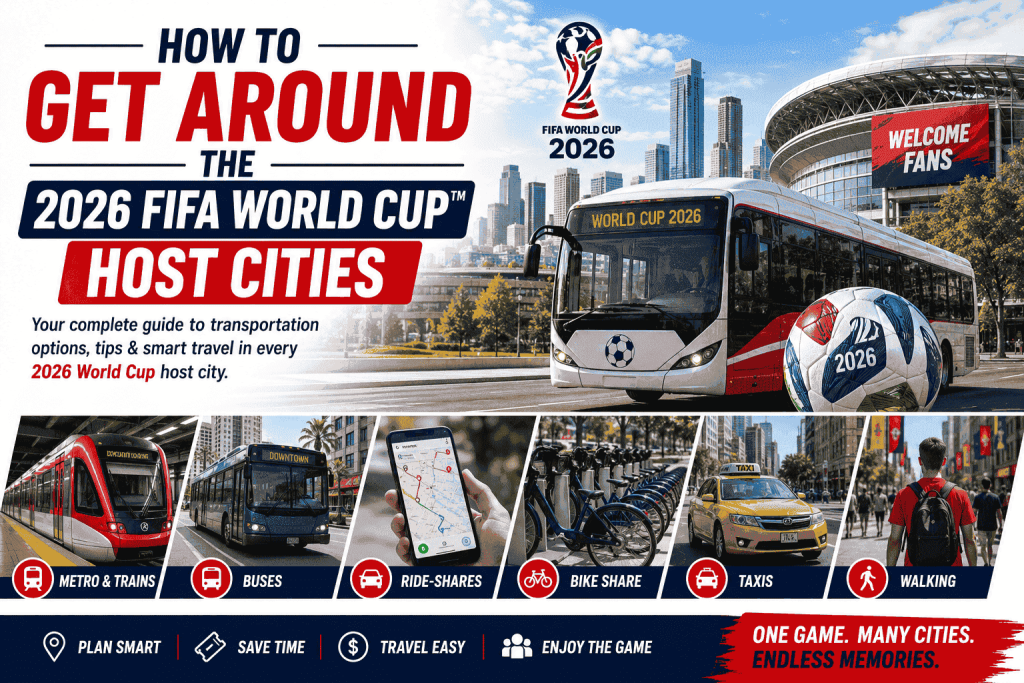
How to Get Around the 2026 FIFA World Cup Host Cities.
The Ultimate Fan Travel Guide: How to Move Between Host Cities During the FIFA World Cup 2026
How to Get From One Host City to Another During the 2026 FIFA World Cup
Find out how to get from the USA, Canada, and Mexico to the FIFA World Cup 2026 host cities. Learn about professional travel plans, financial guidance, flying tips, train routes, and transit options.
How to Get From One Host City to Another During the 2026 FIFA World Cup
The 2026 FIFA World Cup is expected to be the biggest football competition ever. Fans will have an unparalleled chance to witness football on a continental scale with 48 teams, 104 games, and 16 host cities dispersed around the US, Canada, and Mexico. While obtaining match tickets and making hotel reservations are crucial components of organizing a World Cup vacation, knowing how to get between host cities might be the most significant element in guaranteeing a seamless and pleasurable experience.
In contrast to earlier World Cups, which were mostly held in a single nation, the 2026 competition will take place over three countries and thousands of miles. A fan might fly to Toronto for a knockout-stage match after watching a game in Mexico City and then going to another game in Dallas a few days later. Careful transit preparation is necessary for such an extensive agenda.
Fortunately, North America boasts one of the largest transportation systems in the world. Major international airports, domestic aircraft routes, intercity rail services, long-distance buses, rental automobiles, and contemporary public transportation systems will all be accessible to fans. Time may be saved, expenses can be decreased, and the World Cup experience can be greatly enhanced by knowing when and how to use each option.
Knowing the World Cup 2026’s Geography
It’s crucial to comprehend the tournament’s enormous scope before making travel arrangements. In contrast to small-scale competitions held in smaller nations, the World Cup 2026 will take place across much of North America.
Most games are held in the United States, which includes places like New York/New Jersey, Los Angeles, Dallas, Atlanta, Miami, Seattle, Boston, Philadelphia, Houston, Kansas City, and the San Francisco Bay Area. Mexico hosts games in Mexico City, Guadalajara, and Monterrey, while Canada provides Toronto and Vancouver.
Some host cities are very far apart. For instance, it takes more than 4,500 kilometers to get from Vancouver to Miami. In a similar vein, more than 3,500 kilometers separate Seattle and Mexico City. Planning for mobility should be seen as an integral part of the World Cup experience rather than an afterthought because of large distances.
The most popular mode of transportation will be flying.
Flying will be the quickest and most convenient means for the majority of foreign fans to travel between host cities. Almost every host city in North America is connected by direct or connecting flights thanks to the region’s vast aviation network.
Important transportation hubs include major airports including JFK Airport in New York, Los Angeles International Airport, Toronto Pearson International Airport, Mexico City International Airport, Dallas/Fort Worth International Airport, and Hartsfield-Jackson Airport in Atlanta. Moving between tournament locales is very simple because to these airports’ hundreds of daily domestic and international flights.
For instance, a travel from Dallas to Mexico City can be finished in about three hours, whereas a flight from New York to Atlanta usually takes around two hours. When opposed to ground transportation, flying significantly shortens travel times and enables fans to attend several games in various cities in a short amount of time.
However, airfare costs could rise dramatically due to the tournament’s anticipated millions of visitors. Fans should reserve flights as soon as possible and, if at all feasible, be flexible with their travel dates.
The best routes for flights between the host cities
Because they provide regular direct flights, certain host city combinations are especially practical. Among North America’s busiest airline hubs, New York, Atlanta, Dallas, and Los Angeles are great starting points for World Cup travelers.
Combining New York, Philadelphia, Boston, Atlanta, and Miami into a single travel route may be practical for fans attending games on the East Coast. Both train and plane travel provide excellent connections between these cities.
Los Angeles, San Francisco, Seattle, and Vancouver can be combined by fans who are interested in the tournament’s western segment. These cities provide comparatively quick flying times and good airline connections.
Combining Mexico City, Guadalajara, Monterrey, Dallas, and Houston is an option for those who intend to attend games in Mexico. These locations are closer together geographically, and direct flights frequently connect them.
One of the best strategies to lower travel expenses and travel weariness during the tournament is to establish regional travel clusters.
Is Train Travel Possible During the 2026 World Cup?
Trains can be a great alternative for some routes, but flying will still be the most popular method for long-distance travel. Fans can travel straight between city centers, take in beautiful scenery, and skip airport security lines by using rail.
Amtrak runs a number of lines that connect key cities in the United States. Rail travel may be especially practical for those attending games in Boston, New York, Philadelphia, and Washington-area locations. One of North America’s busiest train lines, the Northeast Corridor provides regular service connecting important East Coast cities.
Although flights are still frequently the quicker alternative for lengthy distances, Canada’s rail network also offers links between major cities. While lesser regional routes would still be appealing to certain travelers, Vancouver and Toronto are too far away for practical rail travel during a World Cup schedule.
Trains can be very efficient for certain city pairings where travel lengths are moderate, even though they might not be the best option for traveling across the continent.
Long-Distance Bus Rides for Fans on a Tight Budget
Long-distance bus services can offer substantial discounts for fans looking for the most economical mode of transportation. Businesses in North America provide flexible scheduling and link numerous host cities.
For shorter journeys where airfare could be quite pricey, bus travel is especially helpful. By taking the bus between neighboring cities, you may explore more of the area and save money on transportation.
Time is the primary trade-off. Fans trying to attend games in several far-off destinations in a short amount of time may find bus travel unsuitable because it is typically significantly longer than flying.
Buses can be a useful complement to a traveler’s transportation plan if they are on a tight budget and have flexible timetables.
Is It Worth It to Rent a Car?
Other forms of transportation cannot compare to the freedom and flexibility that car rentals provide. A rental car can improve the whole vacation experience for fans who want to venture outside of the host cities.
In areas where host cities are reasonably close to one another, driving is very appealing. For instance, driving might be convenient for fans going to games in Dallas and Houston. In a similar vein, travelers can take advantage of beautiful highways and other attractions when driving through California’s host cities.
But driving is not without its difficulties. Fuel prices can quickly mount up, parking close to stadiums can be costly, and traffic congestion in large cities can be quite bad. There may also be extra rental requirements while traveling across international borders between the US, Canada, and Mexico.
Flights continue to be more practical than driving for the majority of fans who attend games in several far-off cities.
Traveling Across International Boundaries During the Competition
One distinctive feature of the 2026 World Cup is that some spectators will have to travel across international borders several times. Depending on their match schedule, fans may travel between the US, Canada, and Mexico.
It is important for travelers to make sure their passports are valid during the tournament. Depending on their nationality and itinerary, certain travelers could need visas or electronic travel authorizations.
Maintaining both digital and hard versions of crucial travel papers might help prevent issues. Additionally, fans should budget extra time for immigration and customs processes, especially during periods of high travel demand.
Crossing borders adds difficulty, but it also offers the chance to explore three different cultures in one tournament.
How to Create the Ideal Travel Schedule for the World Cup
Organizing your vacation according to geographic regions is one of the best strategies to lessen the stress associated with travel. Fans should, whenever possible, concentrate on neighboring host cities rather than constantly switching between opposing sides of the continent.
A traveler might, for instance, begin in Mexico City, proceed to Monterrey, take a plane to Dallas, and then proceed to Houston. This approach cuts down on travel time overall and minimizes backtracking.
In a similar vein, East Coast tourists may visit Boston, New York, Philadelphia, and Atlanta before concluding in Miami. Fans from the West Coast might concentrate on Vancouver, Seattle, San Francisco, and Los Angeles.
In addition to saving money, creating a regional itinerary enables a more leisurely travel experience.
Making a Transportation Budget for the 2026 World Cup
For many fans, transportation will probably be one of the biggest costs. The cost of flights, buses, trains, airport transfers, and local transportation may mount up rapidly.
Before buying match tickets, travelers should budget for their transportation. Early flight reservations frequently result in significant savings. By reducing dependency on cabs and ride-sharing services, lodging close to public transportation can further cut expenses.
Costs can also be reduced by using regional transport clusters. There is more money left over for lodging, touring, and matchday activities when there is less travel time between games.
The total expense of travel can be significantly reduced with careful planning.
Local Transportation in the Host Cities
Relocating between cities is just one aspect of the problem. Each host city must be effectively navigated by fans.
Fortunately, robust public transportation systems are available in many World Cup locales. The vast transit systems in New York, Toronto, Mexico City, Vancouver, and Boston facilitate easy access to stadiums and tourism destinations.
In North America, ride-sharing services are readily accessible and can offer practical transportation in situations where public transportation is not available. However, these services may become costly due to surge pricing during significant events.
To make matchday travel easier, many tourists select lodgings close to metro stations or other transit hubs.
Crucial Travel Advice for World Cup Supporters
The most crucial travel tactic for the 2026 World Cup is preparation. There will be exceptional demand for flights, lodging, and transportation services, especially during the knockout stages.
Travel insurance can offer important defense against unforeseen interruptions, cancellations, and delays. In order to save money and increase mobility, fans should also keep an eye on airline luggage regulations and think about packing light.
Throughout the competition, offline maps, digital boarding cards, and mobile travel apps can greatly facilitate navigation.
Lastly, being adaptable can help visitors take advantage of possibilities that present themselves throughout the event and adjust to schedule changes.
Typical Travel Errors to Avoid
Underestimating travel distances is one of the most common errors made by fans. Compared to many prior World Cup host nations, North America is substantially larger, and travel durations might be significant.
Making transportation reservations too late is another frequent mistake. Early reservations are quite advantageous because prices typically rise in response to increased demand.
Attempting to go to too many games in far-off locales might also lead to needless tension. A more enjoyable journey is frequently the outcome of creating a realistic agenda that emphasizes local sites.
Lastly, missing matches and dissatisfaction can result from not accounting for airport transfers, border crossings, and transit delays.
Concluding Remarks
One of the most thrilling parts of the FIFA World Cup 2026 will be traveling between host cities. In addition to seeing top-notch football, fans will get to see three nations, a variety of cultures, and some of the most famous locations in North America.
Careful planning will be necessary whether you decide to take a picturesque road trip, travel by rail along the East Coast, fly between major towns, or combine several modes of transportation. A challenging trip can be turned into an amazing experience by being aware of the location, making travel arrangements in advance, and carefully planning your itinerary.
More than just a football competition, the FIFA World Cup 2026 is expected to be a festival of sport, culture, and travel throughout the entire continent. You may make the most of this historic occasion and make lifelong memories by carefully planning your journey.