
Complete Size, Dimensions, and Structural Comparison Guide
Soccer Field vs Football Field – Sports fields are more than just playing surfaces; they are carefully designed environments that directly influence the tactics, pace, and style of the games played upon them. Among the most recognizable sporting venues in the world are the soccer field commonly known as a football pitch and the American football field, often referred to as the gridiron.
At first glance, both appear to be large rectangular fields marked with white lines. However, a closer examination reveals significant differences in their dimensions, layout, markings, and overall purpose. While American football fields follow a rigid and standardized design, soccer fields offer a degree of flexibility that allows stadiums around the world to vary in size while remaining within official regulations.
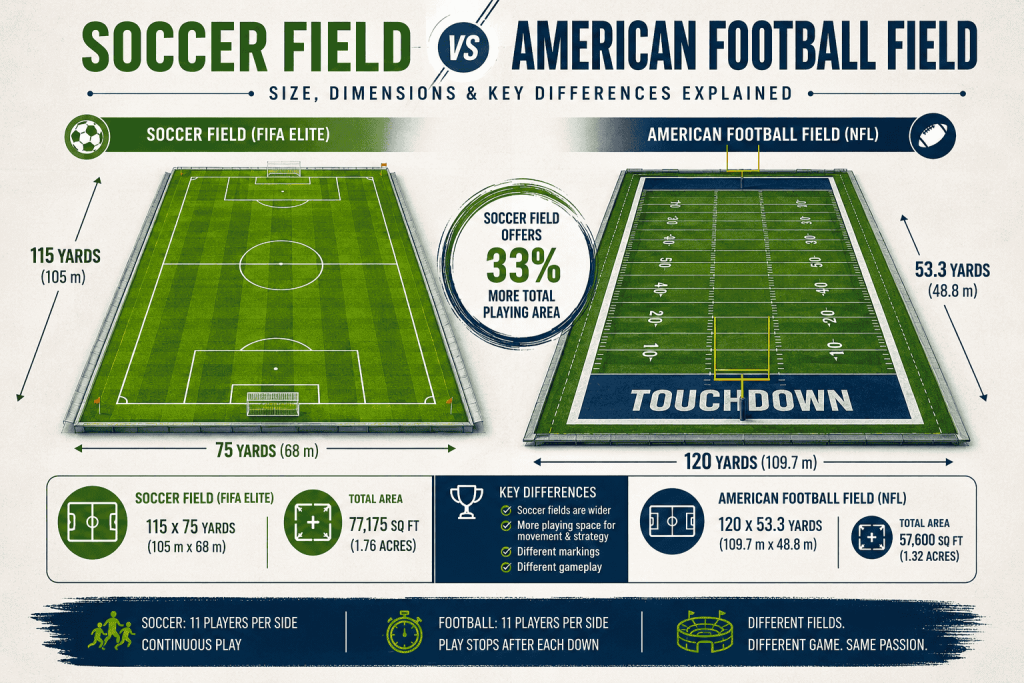
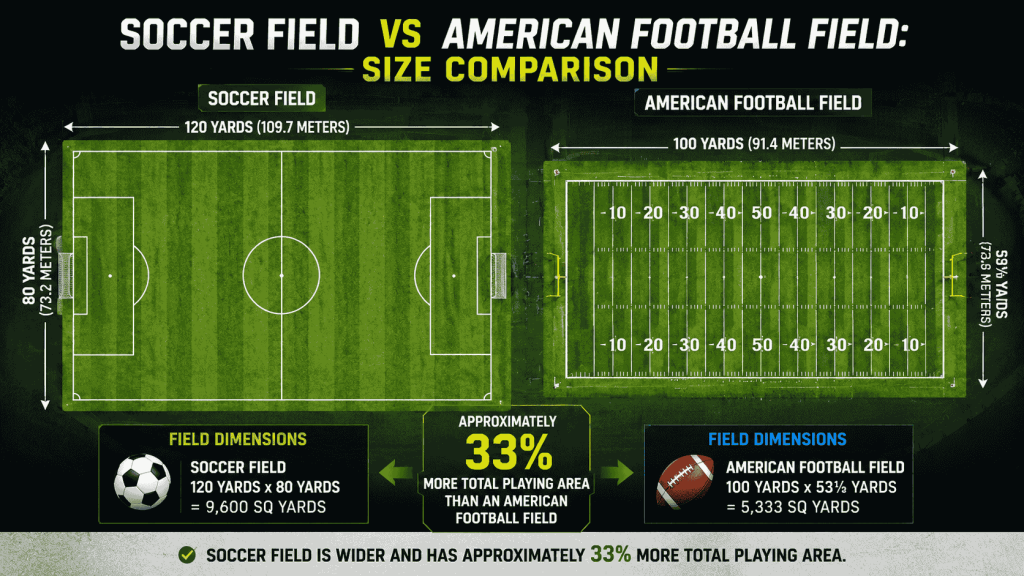
One of the most surprising facts for many sports fans is that a professional soccer field is substantially larger in total playing area than an American football field. Although a gridiron is slightly longer when its end zones are included, a soccer pitch is dramatically wider, resulting in approximately 33 percent more playing space. This additional area supports the continuous movement, strategic build-up play, overlapping runs, and rapid counterattacks that define modern soccer.
With the FIFA World Cup 2026 set to be hosted largely in stadiums originally designed for American football, understanding the differences between these two iconic playing surfaces has become more relevant than ever. This article provides a comprehensive comparison of soccer fields and American football fields, examining their dimensions, layouts, markings, strategic implications, and the engineering challenges involved in accommodating both sports within the same venue.
Understanding the Fundamental Design Philosophy
The most important distinction between soccer and American football fields lies in their underlying design philosophy.
American football is a highly structured sport built around short, controlled plays. Every yard matters, and the field itself is designed to facilitate precise measurements and strategic positioning. Because the sport depends heavily on exact distances, every football field at every level from high school to the NFL is virtually identical.
Soccer, on the other hand, is a fluid and continuous game. Rather than focusing on incremental territorial gains, soccer emphasizes movement, possession, creativity, and space. As a result, soccer governing bodies permit a range of acceptable field dimensions rather than requiring every pitch to be exactly the same size.
This flexibility allows stadium architects to adapt fields to local conditions while maintaining fairness and consistency within international regulations.
American Football Field Dimensions
An American football field follows a strict and standardized blueprint.
The total length of a regulation field measures:
120 yards (109.7 meters)
This total includes:
- 100-yard playing field
- Two 10-yard end zones
The field width is fixed at:
53.3 yards (48.8 meters)
This means every NFL and NCAA field has exactly the same dimensions regardless of location.
Football Field Measurements
| Component | Measurement |
|---|---|
| Total Length | 120 yards |
| Playing Length | 100 yards |
| End Zones | 10 yards each |
| Width | 53.3 yards |
| Total Area | 57,600 sq ft |
| Acreage | 1.32 acres |
Because every field is identical, teams can prepare for games without needing to adjust tactics based on venue size.
Soccer Field Dimensions
Unlike American football, soccer allows variation in field dimensions.
The International Football Association Board (IFAB) establishes acceptable ranges for field sizes.
For standard competitions:
- Length: 100–130 yards
- Width: 50–100 yards
For elite international competitions such as the FIFA World Cup:
- Length: 110–120 yards
- Width: 70–80 yards
The most commonly used professional size is:
105 meters × 68 meters
which equals approximately:
115 yards × 75 yards
Soccer Field Measurements
| Component | Measurement |
|---|---|
| Length | 115 yards (average) |
| Width | 75 yards (average) |
| Total Area | 77,175 sq ft |
| Acreage | 1.76 acres |
The significantly greater width creates much more room for players to move and exploit space.
Which Field Is Bigger?
This question often surprises sports fans.
Many assume American football fields are larger because they appear longer and include end zones.
However, total surface area tells a different story.
Area comparison
American Football Field:
- 57,600 square feet
- 1.32 acres
Professional Soccer Field:
- 77,175 square feet
- 1.76 acres
The difference equals:
19,575 additional square feet
or roughly:
33% more total playing area
This additional space dramatically influences gameplay.
Why Soccer Fields Need More Space
Soccer is a continuous game featuring 22 players moving simultaneously.
Unlike football, where action stops after every play, soccer players constantly reposition themselves both offensively and defensively.
The larger field supports:
Possession-Based Play
Teams need space to circulate the ball and build attacks from the back.
Wing Play
Wide areas allow wingers and full-backs to overlap and stretch defences.
Counterattacks
Fast transitions require open spaces where attackers can exploit gaps.
Tactical Flexibility
Different formations rely on varying uses of field width and depth.
Without the larger dimensions, many modern tactical systems would be impossible to execute effectively.
Field Markings and Layout
One of the easiest ways to distinguish the two fields is by examining their markings.
American Football Markings
Football fields are heavily marked with lines and numbers.
Key features include:
- Yard lines every 5 yards
- Numbered markers every 10 yards
- Hash marks
- End zones
- Goal lines
- Sidelines
These markings are essential because every play begins from a precisely measured location.
The field effectively functions as a giant measuring tool.
Soccer Field Marking
Soccer fields use a much cleaner and simpler design.
Key markings include:
Centre Line
Divides the field into two halves.
Center Circle
A circle with a 10-yard radius used during kickoffs.
Penalty Area
Extends 18 yards from the goal line.
Goal Area
Extends 6 yards from the goal line.
Penalty Spot
Located 12 yards from goal.
Corner Arcs
Used during corner kicks.
Because soccer is continuous, fewer markings are required.
Goals and Scoring Structures
The goals themselves differ dramatically.
American Football Goalposts
Football goalposts are positioned above the end zone.
Dimensions:
- Crossbar height: 10 feet
- Upright height: 35 feet
- Upright width: 18 feet 6 inches
These structures are designed primarily for field goals and extra points.
Soccer Goals
Soccer goals are much larger.
Dimensions:
- Width: 24 feet
- Height: 8 feet
The larger opening is necessary because scoring occurs by sending a ball into the net rather than above a crossbar.
Tactical Implications of Field Size
Field dimensions significantly affect strategy.
American Football Strategy
Football relies on:
- Short bursts of action
- Set plays
- Structured formations
- Precise yardage gains
The narrower field encourages concentrated action and physical battles at the line of scrimmage.
Soccer Strategy
Soccer uses:
- Width creation
- Positional play
- Pressing systems
- Transitional attacks
The larger playing area rewards endurance, spatial awareness, and tactical adaptability.
Modern managers often design entire game plans around exploiting available space.
Physical Demands on Athletes
The different field sizes also influence player fitness requirements.
Soccer Players
Elite soccer players often cover:
- 10–13 kilometers per match
- Continuous movement for 90+ minutes
They require:
- Aerobic endurance
- Agility
- Speed
- Recovery capacity
American Football Players
Football athletes typically perform the following:
- Short explosive movements
- High-intensity sprints
- Frequent physical collisions
Their training focuses more on:
- Power
- Strength
- Acceleration
- Explosiveness
The different field designs reflect these contrasting athletic demands.
Dual-Use Stadium Challenges
One of the most fascinating modern developments involves stadiums hosting both sports.
Many North American venues accommodate:
- NFL games
- MLS matches
- International soccer tournaments
However, fitting a soccer pitch inside a football stadium presents major engineering challenges.
The problem isn’t length.
A soccer field generally fits within the length of a football stadium.
The challenge is width.
A FIFA-standard soccer pitch may be more than 21 yards wider than an NFL field.
FIFA World Cup 2026 and Stadium Modifications
The FIFA World Cup 2026 has highlighted these challenges on a global scale.
Several host venues were originally built for NFL teams.
Examples include:
- AT&T Stadium (Dallas)
- MetLife Stadium (New Jersey)
- Arrowhead Stadium (Kansas City)
To meet FIFA requirements, stadium operators must:
- Remove lower-bowl seating
- Modify field-level infrastructure
- Expand corner areas
- Raise playing surfaces
These renovations ensure that elite international matches can be played on regulation-sized pitches.
Why FIFA Requires Larger Fields
FIFA insists on larger dimensions because elite soccer depends on space.
A narrower field would:
- Limit wing play
- Reduce attacking options
- Encourage defensive tactics
- Alter game balance
Maintaining sufficient width ensures players can perform at the highest level.
The dimensions used in FIFA tournaments are carefully chosen to maximize both fairness and entertainment.
The Future of Sports Venue Design
As soccer continues to grow in popularity across North America, stadium architects are increasingly designing venues capable of accommodating both sports.
Future stadiums may include:
- Retractable seating systems
- Adjustable field surfaces
- Expandable sidelines
- Multi-sport infrastructure
These innovations allow venues to host a wider variety of events while meeting the requirements of different sports.
The trend reflects the growing globalization of soccer and the increasing demand for flexible sporting facilities.
Conclusion
Although soccer fields and American football fields may appear similar from a distance, they are fundamentally different in size, structure, and purpose.
American football fields prioritise precision, uniformity, and controlled gameplay. Every field follows identical dimensions to support a sport built around measured territorial gains and strategic execution.
Soccer fields, by contrast, emphasize fluidity, movement, and space. Their greater width creates approximately 33 percent more playing area, enabling the dynamic attacking and defensive patterns that define the world’s most popular sport.
As FIFA World Cup 2026 approaches and soccer continues expanding throughout North America, understanding these differences becomes increasingly important. Whether viewed from a tactical, architectural, or engineering perspective, the comparison between a soccer pitch and an American football field highlights how the design of a playing surface can shape the very nature of a sport.
Ultimately, both fields are masterpieces of sporting design, each perfectly tailored to the unique demands of the game played upon them.